BroadbandSwitch.uk Relaunches Free Pulse Speed Test to Measure the Lag Behind Evening Broadband Slowdowns
Free, no sign-up, nothing leaves the browser. Pulse measures download, lag and lag when the line is busy, then asks the
Press Release Disclaimer: This is a press release distributed through the XPR Media network. It has not been independently verified by our newsroom.
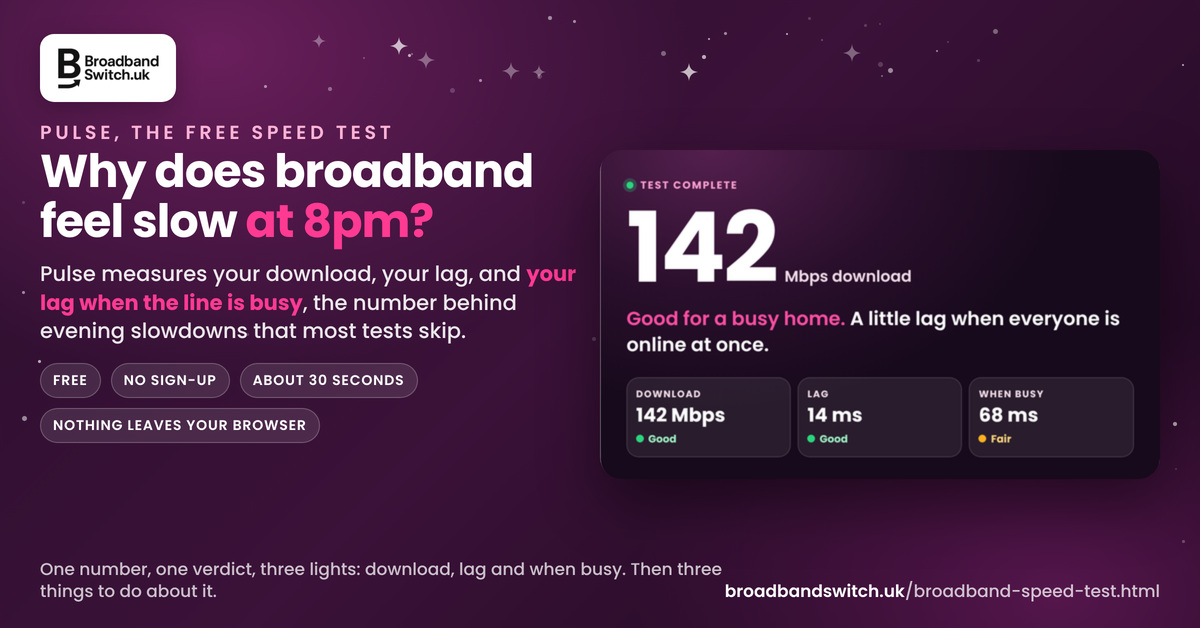

Free, no sign-up, nothing leaves the browser. Pulse measures download, lag and lag when the line is busy, then asks the three questions that matter.
LONDON, ENGLAND, SCOTLAND, WALES & NORTHERN IRELAND, UNITED KINGDOM, October 14, 2026 /EINPresswire.com/ — https://broadbandswitch.uk/broadband-speed-test.html | BroadbandSwitch.uk has relaunched Pulse, its free speed test, with a single result screen and a measurement most speed tests leave out: how a line holds up when it is busy. The test takes about thirty seconds in a browser, needs no sign-up and no app, and keeps the result on the screen; nothing is stored and nothing is sent to BroadbandSwitch.uk. It ends with the three questions a disappointing result raises: is it the Wi-Fi or the line, is the household getting what it pays for, and could it do better at its postcode.
The measurement matters because, on Ofcom’s figures, the evening slowdown is not a drop in speed. In Ofcom’s last home broadband performance report, the average download speed between 8pm and 10pm was 67.7 Mbps against an average maximum of 71.0 Mbps: 95%, a dip of 5%. What changes when a home is busy is lag: the time a quick request, such as a video call or a game move, spends waiting behind the heavy traffic already on the line. Ofcom’s report says most online activities need a response in under 100 milliseconds and some online games in under 50, and a line that answers quickly when quiet can be much slower to answer when it is full. Pulse fills the line on purpose, times requests through the queue and grades the rise from A+ to F. The technical name is latency under load; a bad grade is called bufferbloat.
Key facts
1. Pulse measures four things in about thirty seconds: download speed, lag when the line is quiet, lag when the line is full, and how steady that lag is. It does not measure upload.
2. Ofcom’s peak-time measurement window is 8pm to 10pm. In its last home broadband performance report, the average peak-time download speed was 67.7 Mbps against an average maximum of 71.0 Mbps, or 95% (Ofcom, September 2023).
3. Full fibre lines measured by Ofcom had the lowest lag of any technology, between 4.9 and 7.3 milliseconds, against around 24 milliseconds for ADSL, the oldest copper lines. Ofcom says most online activities need a response in under 100 milliseconds and some online games in under 50 (Ofcom, September 2023).
4. The average UK home broadband connection used 583 GB of data a month in July 2025, up 10% in a year (Ofcom, Communications Market Report 2026).
5. If a line’s speed falls below the minimum guaranteed speed in the contract and the provider cannot fix it within 30 calendar days, Ofcom says the customer may be able to leave without penalty (Ofcom Broadband Speeds Code of Practice).
6. Automatic compensation is £6.46 a day for a delayed start, £32.31 for a missed engineer appointment and £10.34 a day for a total loss of service not fixed after two working days, at the rates in force since 1 April 2026 (Ofcom).
What does Pulse measure?
Download speed is the highest sustained five seconds of a ten second download over six streams. Lag is the middle value of twelve timed requests while the line is quiet; the technical name is idle latency, or ping. When busy is the lag while the line is flat out: timed requests every 450 milliseconds while the download fills the line, with the rise over the quiet figure graded A+ to F. Steadiness, or jitter, is how much the lag wobbles from one request to the next, which is what causes glitches in calls, gaming and live TV. The result screen shows the download number, one verdict sentence and three traffic lights: download, lag and when busy. The grades, the two lag bars and two quick sums, the share of the advertised speed the line delivers and the cost of each megabit on the bill, sit under “More detail”. Every result carries a reference the household can keep.
The relaunch replaces the old composite Pulse Score with that single screen, gives the technical terms plain English names with the technical ones alongside, and cuts the ten sections that used to follow a result to three questions.
Why do evenings feel slow?
On Ofcom’s figures the speed barely changes at 8pm. What changes is how long a quick request waits behind the heavy traffic already on the line. When one person streams in 4K while a game downloads and a backup runs, everything that needs a fast answer, a video call above all, queues behind them. The traffic is growing: the average home connection used 583 GB a month in July 2025, up 10% in a year, and with the clocks going back on 25 October more of it is likely to land in the 8pm to 10pm window Ofcom treats as peak time. Ofcom’s measurements show why the queue matters more than the headline speed: low latency, it says, will greatly improve the performance of some real-time activities such as video calling and online gaming, and full fibre lines had the lowest lag of any technology it measured. Ofcom’s advice is to test more than once, because speed can vary by day and time, and Pulse suggests one run on a quiet morning and one between 8pm and 10pm. For a line that misbehaves at odd hours, BroadbandSwitch.uk’s live quality monitor watches lag, steadiness and bufferbloat over time.
Is it the Wi-Fi, or the line?
Ofcom’s guidance says a slow Wi-Fi test does not always mean there is a fault with the broadband line, and recommends a network cable instead of Wi-Fi where possible. Pulse builds that into the test: after the first result, the router check runs a short second download a metre from the router, by cable or on the 5 GHz band, and sets the two side by side. A big jump means the Wi-Fi is the bottleneck and the line has more to give. About the same means the line is the limit, and a faster package is the fix. Ofcom’s own placement advice applies to the first case: keep the router out in the open, off the floor and roughly central in the home.
Is the household getting what it pays for?
The providers serving most UK homes have signed up to Ofcom’s Broadband Speeds Code of Practice, under which they must give a minimum guaranteed download speed before a customer signs up. Ofcom’s guidance is that if the speed falls below that minimum and the provider cannot get it back above that level within 30 calendar days, the customer may be able to leave the contract without penalty. The residential signatories are BT, EE, NOW Broadband, Plusnet, Sky, TalkTalk, Utility Warehouse, Virgin Media and Zen Internet. Pulse asks for the advertised speed and shows the share the line delivers, and the guide’s advice is to keep three results from three evenings, with the date and time, as the record a complaint needs.
What happens if it goes wrong?
Where a provider is in Ofcom’s automatic compensation scheme, a customer is owed £6.46 for each calendar day a new service starts late, £32.31 for each missed engineer appointment, and £10.34 for each calendar day a total loss of service is not fixed after two full working days, at the rates in force since 1 April 2026. The scheme is voluntary, and ten providers are in it. BroadbandSwitch.uk’s broadband compensation calculator works out what is owed. A complaint that is not settled can go to the Communications Ombudsman or CISAS for free after six weeks, a wait that Ofcom cut from eight weeks on 8 April 2026, and the speed test results are the evidence.
“Most speed tests give you a big number and leave you to guess why the video call still stutters at eight o’clock,” said Dr Alex J. Martin-Smith, founder of BroadbandSwitch.uk, who built Pulse. “The number that explains it is the lag when the line is busy, and almost nobody has been shown theirs. Pulse measures it, grades it, and then asks the only three questions that matter: is it the Wi-Fi, are you getting what you pay for, and could you do better. Nothing is stored and nothing leaves your browser.”
What is a good broadband speed in 2026?
BroadbandSwitch.uk’s guide puts a good speed for most UK homes at 100 Mbps or more: one or two light users are comfortable between 30 and 100 Mbps, a busy household streaming in 4K, gaming and taking video calls at once is most comfortable between 100 and 300 Mbps, and large or smart homes suit 300 Mbps and up. The headroom is there for most addresses: full fibre reaches 82% of UK premises, 42% of fixed broadband connections were full fibre in Ofcom’s 2026 Communications Market Report, and Ofcom’s pricing research found that in many cases customers can switch to faster, more reliable full fibre and pay the same, or less, than for copper or part fibre. Ofcom also found 28% of broadband customers out of contract, with customers in contract paying £7 to £9 a month less. Prices vary by postcode, and so does the saving.
Could the household do better?
If the line is the limit, probably. Every result ends on a postcode box: consumers can compare broadband deals at a postcode, see every provider that reaches the exact address with the lowest monthly price first, and let the new provider manage the switch under One Touch Switch, the process used for 3,431,195 switches by 3 September 2026. The result is the before; the postcode shows the after.
“A speed test should end with something you can do, not a number you can feel bad about,” said Adrian James, broadband editor at BroadbandSwitch.uk, who reviewed the test. “Run it where you sit, run it by the router, run it at eight o’clock, and you know whether to move the router, call your provider or move provider. That is the whole point of it.”
Where is the test?
Pulse, the free broadband speed test, is on BroadbandSwitch.uk, with the router check, the two sums, the rights in three lines, a guide to what each number means and thirteen answers to the questions people ask about speed. It runs on phones, tablets and computers in the browser, with no app to install.
Does Pulse store results?
No. The result stays on the screen. Pulse sets no cookies, stores nothing in the browser and sends nothing to BroadbandSwitch.uk; the only connection it makes is to the public speed endpoint it downloads from. The household can copy the result or keep the reference for its records or a complaint. Because nothing is stored, BroadbandSwitch.uk publishes no league tables from Pulse.
About BroadbandSwitch.uk
BroadbandSwitch.uk is an independent UK broadband comparison service, part of the SearchSwitchSave group. It earns a commission when a customer orders through its comparison, which does not change the price the customer pays. Deals are listed by monthly cost, lowest first, and commission never decides the order. Its guides and Data Lab reports are written by named authors and carry a public corrections log. Customer line: 0330 122 1223.
Notes to editors
1. How Pulse measures. The test runs in the browser against Cloudflare’s public speed endpoint: six parallel download streams for ten seconds, twelve idle latency probes, and loaded probes every 450 milliseconds while the download runs. The bufferbloat grade is based on the rise in latency under load over idle latency. Pulse does not measure upload, and it is a snapshot: the line, the Wi-Fi, the device and the time of day all move the number, which is why the page asks for more than one run. BroadbandSwitch.uk earns nothing from any provider for what Pulse shows.
2. Ofcom’s most recent home broadband performance report covers measurements from March 2023 and was published on 14 September 2023; it remains Ofcom’s latest published measurement of peak-time speeds and latency by technology. Its peak-time analysis covers download speed; its latency figures are 24 hour averages by technology.
3. Free tools referred to in this release, all on BroadbandSwitch.uk: the Pulse speed test, the live broadband quality monitor, which watches lag, steadiness and bufferbloat over time, the broadband speed calculator, the compensation calculator, and the One Touch Switch map and video on the switching hub. Addresses for each are available from the contact below.
4. The five images with this release are free to reuse with a credit and a link to the test. Dr Alex J. Martin-Smith and Adrian James are available for interview on 0330 122 1223.
References
Cloudflare. (2026). Cloudflare speed test.
Ofcom. (2023, September 14). UK home broadband performance: Measurement period March 2023.
Ofcom. (2026, February 26). New Ofcom research reveals how to cut phone and internet bills.
Ofcom. (2026, April 8). Quicker complaints resolution for telecoms customers, under new Ofcom rules.
Ofcom. (2026, May 13). Connected Nations update: Spring 2026.
Ofcom. (2026, June 30). Communications market report 2026.
Ofcom. (2026, July 20). Automatic compensation: What you need to know.
Ofcom. (2026, August 25). Get help with broadband and Wi-Fi problems.
Ofcom. (2026, September 12). Around 3.5 million Brits hit switch amidst cost-of-living concerns.
Ofcom. (2026, October 8). Broadband speeds codes of practice.
Dr. Alex Martin-Smith CMgr DBA
Upleashed Limited® | Including BroadbandSwitch.uk
+44 330 122 1223
press@broadbandswitch.uk
Visit us on social media:
LinkedIn
Bluesky
Instagram
Facebook
YouTube
TikTok
X
Other
Broadband Speed Explained: What the Numbers on Your Speed Test Mean
Legal Disclaimer:
EIN Presswire provides this news content “as is” without warranty of any kind. We do not accept any responsibility or liability
for the accuracy, content, images, videos, licenses, completeness, legality, or reliability of the information contained in this
article. If you have any complaints or copyright issues related to this article, kindly contact the author above.

Media gallery