
Neural holography enabled multi-beam steering for multi-task classifier
SHANNON, CLARE, IRELAND, October 13, 2026 /EINPresswire.com/ -- Announcing a new publication from Opto-Electronic
Press Release Disclaimer: This is a press release distributed through the XPR Media network. It has not been independently verified by our newsroom.

SHANNON, CLARE, IRELAND, October 13, 2026 /EINPresswire.com/ — Announcing a new publication from Opto-Electronic Technology; DOI 10.29026/oet.2026.260019.
In the era of rapid artificial intelligence (AI) development, traditional electronic computing architectures are facing bottlenecks in energy consumption, latency, and bandwidth. Optical and optoelectronic computing can accelerate AI inference. The Diffractive Optical Neural Network (DONN) utilizes light wave propagation to perform neural network computations, enabling ultra-high-speed and low-energy information processing. However, to achieve multi-task processing on a unified platform, it typically requires adjusting the laser wavelength/polarization or relying on complex mechanical hardware reconfiguration. This significantly increases the cost of optical hardware and the difficulty of system alignment. How to efficiently accomplish multiple tasks within a unified and compact optical architecture has become a key challenge in the field of optoelectronic computing.
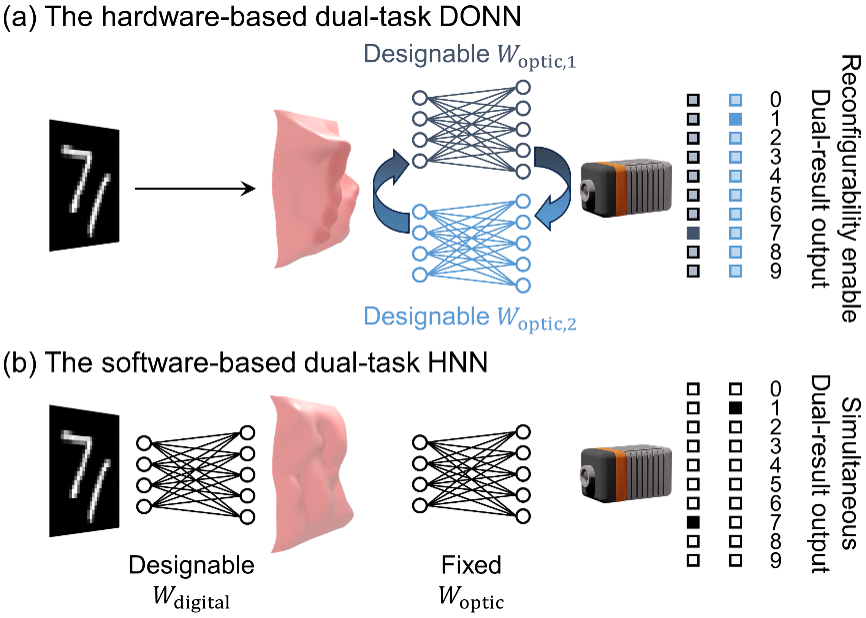
To address this pain point, the research team from China Information Communication Technologies Group Corporation (CICT), in collaboration with Peng Cheng Laboratory, Wuhan University, and Nanyang Technological University, proposed to introduce neural holography technology into optoelectronic neural networks to construct an end-to-end Holographic Neural Network (HNN). This system utilizes a single phase-only spatial light modulator (SLM) to simultaneously implement the input layer based on electronic information phase encoding and the computing layer based on optical diffraction modulation. Benefiting from the simple optical architecture and flexible neural holographic algorithms, the system can simultaneously process multiple image recognition tasks through intelligent beam splitting and steering without the need for physical hardware reconfiguration or multiplexing, achieving “one brain for multiple uses”, as shown in Figure 1.
The State Key Laboratory of Optical Communication Technologies and Networks (OCTN), and the National Information Optoelectronics Innovation Center (NOEIC) affiliated with China Information and Communication Technology Group Corporation (CICT), together with Peng Cheng Laboratory, Wuhan University, and Nanyang Technological University, published a research article titled “Neural Holography enabled Multi-Beam Steering for Multi-Task Classifier” in the 2026 issue 3 of Opto-Electronic Technology. The system adopts an end-to-end optoelectronic joint training framework, using a single phase-only SLM to simultaneously undertake the dual roles of input data encoding and diffraction modulation. It then uses light propagation to complete complex parallel computations, with the camera ultimately directly outputting the classification results. This process fully exploits the nonlinear characteristics of the electrical-to-optical conversion process at the input layer. Due to the low complexity of the optical system, the offline simulation training highly aligns with the experimental inference results, as shown in Figure 2.
Different from the conventional multi-task DONNs that rely on multi-dimensional physical quantity multiplexing or mechanical reconfiguration, the research team, inspired by the cross-stitch multi-task network architecture, proposed a phase-multiplexing holographic scheme, and a corresponding joint training algorithm. By introducing a task correlation factor during the error backpropagation process, the crosstalk between multiple tasks is effectively reduced, and multi-task learning performance is improved. When two related tasks (such as dual-digit recognition) are trained together, the recognition accuracy of the multi-task network even exceeds that of a single-task network. For different types of tasks, such as handwritten digit and fashion item recognition, optimizing the task correlation factor can also effectively suppress task interference, as shown in Figure 3. Furthermore, the research team demonstrated the scalability of this method, achieving synchronous recognition of four tasks while maintaining a classification accuracy of approximately 90%.
Keywords: photonic neural network, pattern classification, optical wireless communications, intelligent beam steering, optical holography
# # # # # #
The Optoelectronic Devices Research Department of the State Key Laboratory of Optical Communication Technologies and Networks under CICT is dedicated to the basic and applied research in computational optics and holography, computing-oriented advanced optoelectronic devices, and intelligent optical wireless communications. The group has published multiple high-impact papers and received support from various national, provincial, ministerial, and corporate innovation projects, providing foundational support for the development of next-generation intelligent beam control and optoelectronic AI information processing technologies.
# # # # # #
Opto-Electronic Technology (OET) is an international, peer-reviewed and open access English language journal. OET publishes reviews, research articles and letters covering engineering technologies and applications of optics, photonics and optoelectronics.
# # # # # #
More information: https://www.oejournal.org/oet/en/
Editorial Board: https://www.oejournal.org/oet/en/editorial_board/oetEditorialBoard
All issues available in the online archive (https://www.oejournal.org/oet/archive_list_en)
Submission of OET may be made using ScholarOne (https://mc03.manuscriptcentral.com/oet)
ISSN (Print) 2097-6003
CN 51-1811/O4
Contact Us: oet@ioe.ac.cn
Twitter: @OptoElectronAdv (https://twitter.com/OptoElectronAdv?lang=en)
WeChat: OE_Journal
# # # # # #
Wu L, Wu M, Li Z et al. Neural holography enabled multi-beam steering for multi-task classifier. Opto-Electron Technol 2, 260019 (2026). DOI: 10.29026/oet.2026.260019
Opto-Electronic Technology Editorial Office
Opto-Electronic Technology
+ 12345678999
Legal Disclaimer:
EIN Presswire provides this news content “as is” without warranty of any kind. We do not accept any responsibility or liability
for the accuracy, content, images, videos, licenses, completeness, legality, or reliability of the information contained in this
article. If you have any complaints or copyright issues related to this article, kindly contact the author above.

Media gallery

